
International connections advance knowledge exchange for product development
Thursday, November 26, 2026 Abby Wolfe & Deanna Jones
This post was published in internal Canadian Blood Services communications and has been reposted with permission.
Through the Health Emergency Resilience Operations (HERO) program (announced in June), Canadian Blood Services is accelerating important work already underway to strengthen Canada’s blood system through research, innovation, and preparedness.
Across the organization, teams are advancing projects that have the potential to support readiness in a variety of settings.
As part of the HERO program, Canadian Blood Services is exploring a number of innovative blood products and technologies to better understand how they may contribute to future preparedness, resilience and patient care.
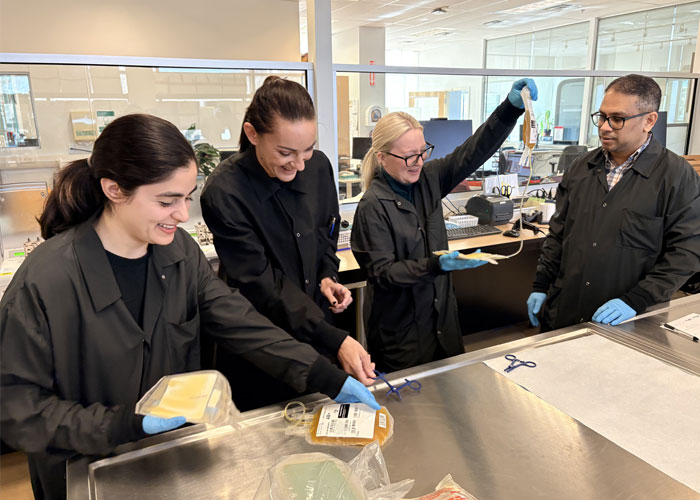
Earlier this year, members of the Network Centre for Applied Development (netCAD) welcomed a leading international expert in cryopreserved platelets for a knowledge exchange focused on exploring the feasibility and development considerations associated with this product.
Dr. Lacey Johnson, a principal research fellow at Australian Red Cross Lifeblood and adjunct associate professor at the School of Science, Royal Melbourne Institute of Technology (RMIT) University, joined the team at their Vancouver-based facility.
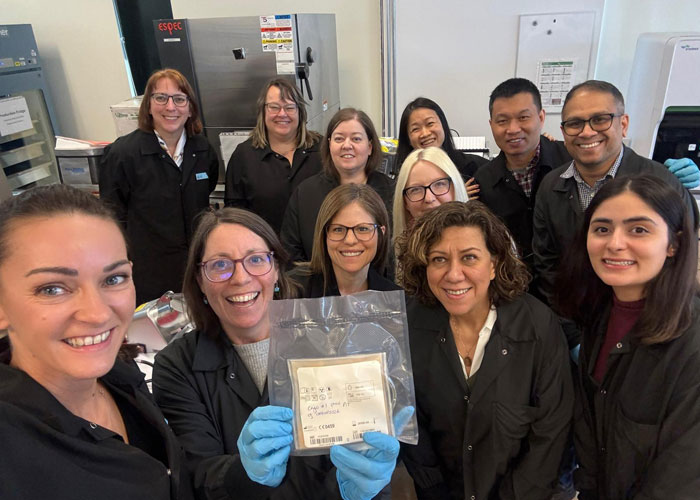
“The visit provided an important opportunity for the team to learn from Dr. Johnson’s hands-on experience with cryopreserved platelet manufacturing,” said netCAD’s associate director, Anita Howell. “Though the process will require significant adaptation for use with Canadian Blood Services’ platelet components, the team was able to complete a test-run under Dr. Johnson’s guidance, producing the very first research prototype of a cryopreserved platelet.”
Platelets are typically stored at room temperature for 7 days. Research into cryopreserved platelets aligns with Canada’s focus on enhancing resiliency in the product supply chain by extending storage abilities and potentially improving availability in challenging environments.
This work is part of one of the pillars of focus in the HERO program: strengthening Canada’s readiness and resilience through the development of innovative blood components that can support patient care in both routine and emergency situations.
If ultimately proven suitable for the Canadian context, cryopreservation techniques may offer opportunities to improve product availability for remote or austere environments where access to fresh blood products is limited. It can also make it possible for unique, HLA-matched products to be stored longer, enhancing availability for patients with specific needs.
“One potential benefit of products with longer storage duration is improved availability of blood components in challenging environments, which could help strengthen Canada’s ability to respond in any circumstance,” said Dr. Chantale Pambrun, senior medical director.
Adapting the Australian experience
Australia began pursuing cryopreservation for platelets more than a decade ago. Since then, trials such as CLIP-II have received millions of dollars of investment from major Australian Research Councils generating clinical data to better understand the safety, effectiveness, and potential applications of these products.
However, the characteristics of Australian-produced platelets differ from what is familiar in the Canadian setting. This raises important questions about how the experience and learnings from one setting can be transferred and adapted to the needs of another.
Through this visit, the netCAD team and Dr. Johnson were able to engage in two-way knowledge sharing that brought those questions to the forefront, leveraging the strengths of each unique perspective to explore considerations for process optimization and how the best possible product quality can be achieved.
Supporting new product development for the Canadian setting
As with any early-stage product development effort, significant research, evaluation, and decision-making remain before future applications can be determined. Though it will require much more refinement in the months and years ahead, the netCAD team was able to complete a test-run under Dr. Johnson’s guidance, producing the very first prototype of a cryopreserved platelet unit using Canadian Blood Services’ platelets.
“The key takeaway of this experience is that our international collaborations and cross-functional partnerships are essential as we develop and introduce new products at Canadian Blood Services,” said Dr. Pambrun. "By fostering meaningful knowledge exchange across borders, we can share expertise, spark new ideas, and advance innovation together."
Canadian Blood Services – Driving world-class innovation
Through discovery, development and applied research, Canadian Blood Services drives world-class innovation in blood transfusion, cellular therapy and transplantation—bringing clarity and insight to an increasingly complex healthcare future. Our dedicated research team and extended network of partners engage in exploratory and applied research to create new knowledge, inform and enhance best practices, contribute to the development of new services and technologies, and build capacity through training and collaboration. Find out more about our research impact.
The opinions reflected in this post are those of the author and do not necessarily reflect the opinions of Canadian Blood Services nor do they reflect the views of Health Canada or any other funding agency.
Related blog posts

Thursday, November 06, 2025
Abby Wolfe
Every day, blood donations are manufactured into the lifesaving blood components that Canadian Blood Services provides to meet patients’ and healthcare systems’ diverse needs. While the Clinical Guide to Transfusion provides information about these components to healthcare providers, this blog describes how research activities happening behind the scenes continuously inform and improve how blood components are collected, manufactured, stored and utilized.